
Lithium iron phosphate batteries (LFP) are taking the global energy market by storm in 2026.
Leading automotive manufacturers such as Tesla, BYD, Ford, and Volkswagen rely heavily on LFP battery cells to power their expanding electric vehicle lineups. Major energy storage companies also depend on LFP systems for residential, commercial, and large-scale grid applications. This broad adoption shows how LFP has moved into the mainstream.
But what are LFP battery cells, and what are the benefits of using them? Let’s see:

What is an LFP battery and Its Advantages over Other Batteries?
The current battery market offers various types, but the primary ones in the power and energy storage sectors are lead-acid batteries and lithium-ion batteries.
- Lead-acid batteries are a traditional type, valued for their low cost and mature technology.
- Liquid lithium-ion batteries primarily consist of a cathode, an anode, a separator, and an electrolyte. The anode typically utilizes graphite, and the key differences among them stem from the differences in their cathode materials. The mainstream lithium-ion battery types include lithium iron phosphate (LiFePO4 or LFP), nickel manganese cobalt (NMC), and nickel cobalt aluminum (NCA).
Among them, LFP battery cells stand out for their strong safety record, stable performance, and long service life.
Let’s have a look at how LiFePO4 battery cells differ from other types:
| Lead-acid Battery | LFP Battery | NMC Battery | NCA Battery | |
| Initial Cost | Low | Moderate | High | Very High |
| Energy Density | Low | High | Very High | Very High |
| Safety | Mature technology, but risks present | High; excellent thermal stability; BMS risk manageable | Moderate; requires strict thermal management | Lower; strict thermal management required; higher safety risks |
| Cycle Life | Short | Extremely Long | Moderate | Short to Moderate |
| Maintenance | Simple or None | Requires BMS and thermal control; lower complexity | Requires complex BMS and thermal management | Requires complex BMS and thermal management |
Compared with lead-acid batteries, LFP battery cells last longer, are safer, and store more energy. Compared to NMC and NCA, although the latter have higher energy density, LFP is safer and more stable, making it better for long-term use.
In summary, why are LFP batteries gaining popularity?
- Longer cycle life.
- Lower manufacturing costs and no dependence on cobalt or nickel, although their energy density is lower than that of NMC or NCA batteries.
- Higher thermal stability, meaning they are less prone to overheating or thermal runaway.
China has maintained a central role in the global production and technological progress of LFP batteries. This position is supported by its strong industrial base, ample raw material supply, and significant investment in research and development.
In this context, REPT BATTERO’s proprietary Wending battery technology represents one of the advances in LFP technology. By optimizing the internal structure of the cells, this technology aims to improve space utilization and energy density. These improvements bring to market more compact systems, faster charging speeds, and longer service life.
We welcome you to contact us to explore our advanced battery product lineup.
Core Applications of LFP Battery Cells
Nowadays, LFP battery cells are widely used in a number of industries, such as:
1. Energy Storage Systems
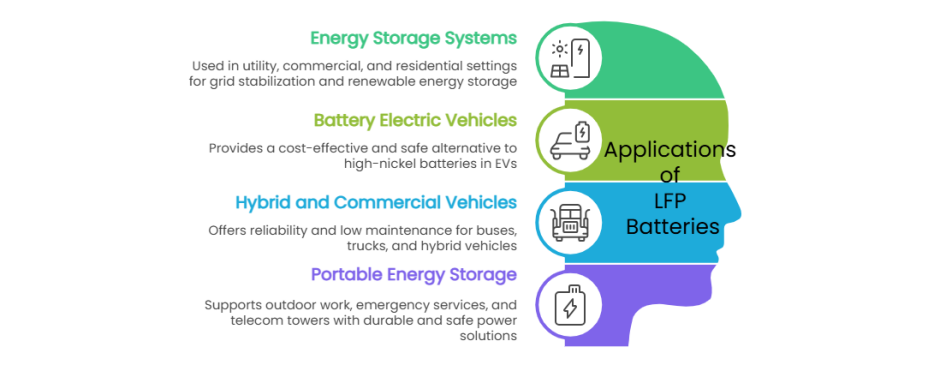
LFP batteries are the backbone of modern energy storage. Large utility projects depend on them to stabilize grids, store renewable energy, and manage power fluctuations. Commercial and industrial facilities use LFP systems to balance peak demand and maintain steady operations during outages. Residential users are also adopting compact storage units powered by LFP to pair with solar panels, allowing homeowners to save energy and gain independence from the grid.
Further reading: Your Ultimate Guide to Industrial & Commercial Energy Storage
2. Battery Electric Vehicles
The use of LFP batteries for EV applications has grown rapidly because they balance safety, cost, and energy performance better than other car battery types. Many new EVs with LFP batteries are now entering the market, giving automakers a dependable and cost-effective alternative to high-nickel chemistries. LFP battery Tesla and Ford are some common examples in this regard.
Further reading: New EV Battery Technology: Gain the Highest EV Competitiveness
3. Hybrid Vehicles and Commercial Vehicles
Bus fleets, logistics trucks, and hybrid vehicles value batteries’ ability to perform during frequent charge and discharge cycles. LFP battery cells’ resistance to overheating and minimal maintenance needs reduces downtime and operating costs. This dependability makes LFP an essential choice for businesses that prioritize consistent performance and long service life.
4. Portable Energy Storage and Special Applications
Beyond grid storage and transportation, LFP battery cells are widely used in specialized applications. Portable power units for outdoor work, emergency services, and recreational activities also benefit from their durability and dependable safety profile. Telecom towers, remote off-grid systems, and marine operations also rely on LFP technology to maintain continuous service in demanding environments. Their stability across different climates and minimal fire risk make them a dependable choice.
Market Trends and Future Outlook 2026
Global adoption of LFP battery cells keeps on climbing in 2026.
The IEA reports that LFP batteries made up nearly half of the EV battery market in 2024[1]. This share continues to rise as manufacturers push for lower costs and stable supply chains.
The use of LFP battery cells in energy storage solutions also shows positive trends. In the U.S., projections point to 15.2 GW / 48.7 GWh of new storage capacity installed across all market segments in 2025[2]. Among these, the utility-scale segment topped the list with over 1.5 GW of new installed capacity, representing a significant 57% increase compared to Q1 2024[2,3].
Meanwhile, China continues to lead in production and deployment, boosting domestic capacity and helping lower manufacturing costs worldwide. Europe is rapidly advancing in stationary energy storage, driven by renewable energy goals and the need for grid stability. In the United States, the shift toward LFP batteries in passenger EVs has been slower, but new domestic battery plants and evolving supply strategies are helping the country catch up.
REPT BATTERO: Your Energy Partner
As a professional LFP battery manufacturer and LFP battery supplier, we at REPT BATTERO are committed to advancing LFP technologies. We understand that every application scenario is unique, which is why we have built a comprehensive battery product matrix serving utility-scale, commercial, and industrial energy storage, residential energy storage, and battery electric vehicles.
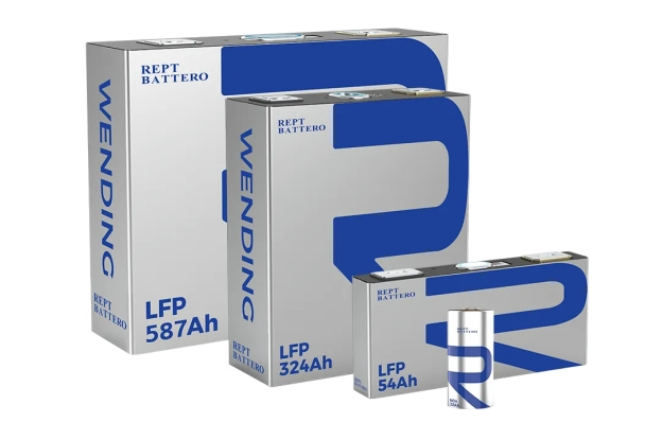
- In the energy storage sector, REPT battery cells, such as our 314Ah cells, achieve cycle life of 10,000 to 14,000 cycles and above. For next-generation 6.25MWh+ systems, we have also launched 392Ah and 587Ah LFP battery cells, reaching an energy density of 190Wh/kg, efficiency exceeding 96% (0.25P), over 10,000 cycles, and a calendar life of more than 20 years.
- In the electric vehicle sector, we are advancing the development of 4C–6C ultra-fast charging batteries. The energy density of our LFP cells has been increased to 195–200 Wh/kg, thereby extending vehicle range.
If you wish to learn more about how our high–efficiency batteries can create value for your project, we invite you to explore REPT BATTERO’s solutions.
FAQs
LFP vs NMC Battery: Which Works Best for Electric Vehicles?
LFP batteries have advantages in safety, lifespan, and cost, while NMC batteries offer higher energy density.
For users/manufacturers who prioritize long-term reliability and total ownership cost, the LFP battery for EVs is a safer and more economical choice; those seeking high energy density and peak performance may prefer NMC.
Are LFP batteries more durable than NMC? How different is the cycle life?
Yes, LFP batteries are generally more durable. Their cycle life far exceeds that of NMC, typically reaching over 2,000 cycles, and excellent products can even surpass 6,000 cycles—about 2–3 times that of NMC (usually 1,000–2,000 cycles).
For example, REPT BATTERO’s 314Pro cell supports up to 12,000 cycles, significantly reducing replacement frequency and maintenance costs, making it suitable for long-term deployment.
Can LFP battery cells be used for high-power or fast-charging scenarios?
Yes. Modern LFP battery cells, combined with high-efficiency battery technology, can support 4C–6C fast charging while maintaining safety and long life.
Our proprietary Wending battery technology uses a patented top-cap design and seamless welding process, integrating innovative battery structures with advanced solid-liquid interface technology to optimize space utilization and structural stability. This technology is compatible with both LFP and NCM chemistries, enhances energy density, enables fast charging, and provides exceptional safety for high-power EV and energy storage applications.
What is the price trend for LFP batteries?
Since they do not rely on cobalt or nickel, LFP battery cells are generally more stable and have lower costs. With increased production capacity and a mature supply chain, prices are expected to continue decreasing, making LFP a cost-effective long-term choice.
LFP battery quality varies widely on the market. How to choose reliable LFP battery suppliers/manufacturers?
When selecting, it is recommended to focus on a supplier’s technical R&D strength, large-scale manufacturing capability, and real-world market reputation.
We welcome customers to visit our technology and products for customized evaluations. REPT BATTERO provides fast-response technical support, promising an initial response within 2 hours and a complete solution within 7 days.
References:
- IEA (2025), Global EV Outlook 2025, IEA, Paris https://www.iea.org/reports/global-ev-outlook-2025, Licence: CC BY 4.0
- U.S. energy storage market sees record growth in Q1 2025. Available at: https://pv-magazine-usa.com/2025/06/25/u-s-energy-storage-market-sees-record-growth-in-q1-2025/ (Accessed: 20 October 2025)
- REPORT: Energy Storage Market Continues Strong Growth in Q1 2025. Available at: https://cleanpower.org/news/u-s-energy-storage-monitor-q2-2025/ (Accessed: 20 October 2025)